CODIMI Voluntary Certification Scheme

Mandatory product listing schemes are normally designed to address the fundamental regulatory requirements for defined fire safety products and standard applications. They provide an important baseline for statutory compliance, but they may not always fully address new product developments, enhanced performance claims, innovative constructions or additional assurance requirements above the minimum regulatory expectation.

The CODIMI Voluntary Certification Scheme provides a structured third-party certification route for fire safety products and systems where independent assurance is required beyond, outside or in addition to a mandatory regulatory product listing scheme.

The scheme is particularly suitable for product innovation, enhanced performance verification, market differentiation and independent certification of products that are not yet fully covered by a mandatory listing route, or where the manufacturer wishes to demonstrate a higher level of controlled performance than the baseline regulatory requirement.

It may be used for enhanced voluntary certification, innovation-led certification, international market certification, purchaser-specified certification, or certification against standards, specifications or technical criteria accepted by CODIMI.

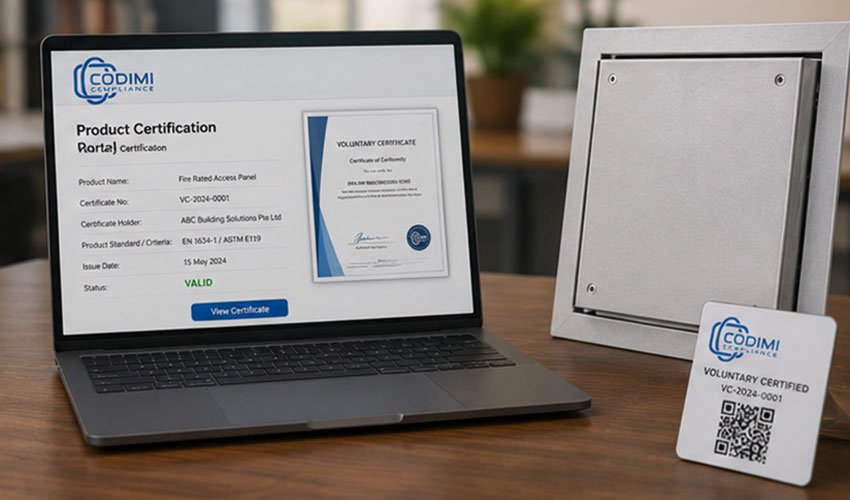
Purpose of voluntary certification

Voluntary certification provides a higher level of assurance than a standalone test report and may also provide additional assurance beyond the fundamental requirements of a mandatory scheme.

It helps demonstrate that:

The product has been independently reviewed by a Certification Body;
The test evidence is relevant to the product and intended application;
The certified scope is clearly defined;
Enhanced or additional performance claims have been reviewed against defined criteria;
Product innovation, new materials, new constructions or alternative configurations have been evaluated within a controlled certification framework;
Production and quality controls have been evaluated where required;
Certified products can be listed for independent verification;
Changes to the product, materials, manufacturing location or production process are subject to control;
Additional surveillance, inspection or verification can be applied where appropriate.

Voluntary certification is particularly useful where a manufacturer wishes to demonstrate that a product offers performance, scope, quality control or traceability beyond the minimum mandatory requirement.

Book a call
Codimi background picture
sky

Typical applications

The scheme may be suitable for:

Innovative fire safety products not yet fully addressed by an existing mandatory product listing route;
Enhanced product variants offering performance above the minimum regulatory baseline;
New materials, new constructions or alternative system configurations requiring independent verification;
Manufacturers seeking independent certification to support market entry or market differentiation;
Products intended for international markets where third-party certification is commercially required;
Products requiring certification against recognised standards, technical specifications or defined performance criteria;
Products where purchasers, consultants, insurers or asset owners require additional independent assurance;
Bespoke or specialist systems requiring a controlled certification framework;
Products requiring additional surveillance, production control or traceability beyond basic compliance.
Book a call

Important limitations

Voluntary certification does not automatically replace statutory approval, mandatory product listing, project approval or acceptance by any authority having jurisdiction.

Where a product is intended for a regulated market or regulated project, the applicant remains responsible for confirming the applicable legal, regulatory, contractual and project-specific requirements.

CODIMI can assist by identifying the likely certification route, applicable standards, required evidence and technical gaps at an early stage.